Line Boring Instructions. CLICK FOR HOMEPAGE


Line Boring Instructions

Click for our PORTABLE LINE BORING MACHINES and EQUIPMENT

Clic para ver las instrucciones lineas maquinado en espaņol
ALWAYS WEAR SAFETY GLASSES ! * ALWAYS KEEP HAIR, CLOTHING, HANDS AND FINGERS CLEAR!

It helps to have a 2nd person to assist with the setup, especially when positioning a long boring bar.
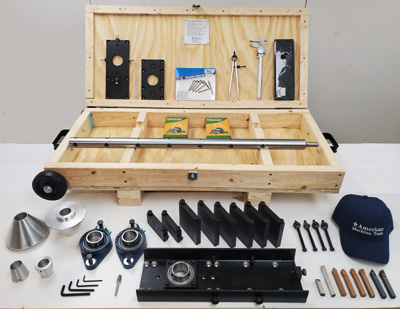
This is intended for reboring pivot holes in heavy equipment such as cranes, backhoes, endloaders, excavators and tractors powered by your variable speed magnetic drill with a 3/4 inch [19mm] capacity drill chuck and a long drill press stroke. If you dont have a big magnetic drill press, we can sell you one. Our equipment can also be used to rebore holes on machinery side frames, mounting flanges, printing press frames, steel mill ladles, bridge pivots, etc. The words boring bar and shaft mean the same thing. The words standoffs and riser blocks mean the same thing. Call us for tech support at 1-773-334-5000 if needed Monday to Friday. Read the instructions and study the assembly drawings we provide with the equipment.

WARNING: Grind off or bore out galled metal before welding, because if you weld on top of galled metal, the weld will absorb carbon from the galled metal and harden too much.

NOTE: You need have the patience to carefully set up the equipment, manipulate speed, feed, depth of cut and choice of cutter. If you follow these instructions you can line bore most holes though some jobs will require one or more optional attachments.

Our equipment line bores using a magnetic drill press with a long stroke, variable speed and 3/4 inch chuck. An adjustable position base helps. Make sure the slide gibs of your magnetic drill press are adjusted snug but not too tight. The drill head should slide smoothly but not too loose that you get unwanted vibration.

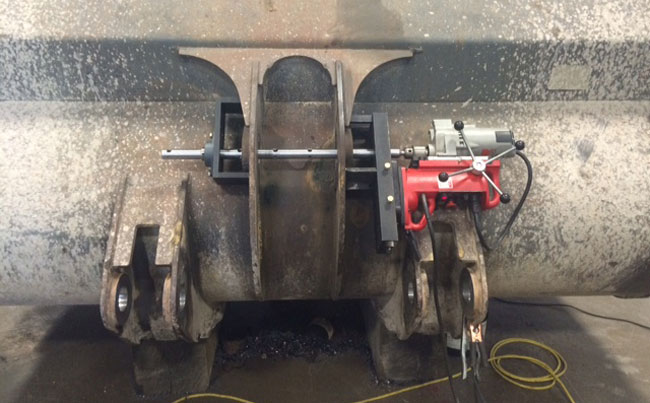
Customer shows how he was multi-tasking by setting up the Q150 with Milwaukee magnetic drill to line bore from the right side and bore weld with the BOA-408-AMT from the left side.

1) To get started, insert the boring bar into the worn holes.
2) When holes get egg shaped there is usually part of the hole that is not worn out and then you can reference off of whats left of that part of the original hole diameter. Using two holes to repair, insert one centering cone against the good side of each worn hole. The further apart the holes are, the better. Use the smaller aluminum cones for smaller holes and the larger aluminum cones for larger holes. If you have an older AMT Line Boring Kit you can use the alignment sleeves for small holes, just carefully wrap duct tape concentrically around the outer diameter of each sleeve to match the old diameter of the hole. It sounds strange but tape works. If the holes are too worn to find any of the original diameter to position the cone against, then you can try to center by measuring from the outer boss. Insert a cutter in one of the square holes a clamp it in place once you have the boring shaft centered in the hole.
3) Tighten the set screws in the cones. You can hold the cone & boring bar up against the good side of the hole or use a bungee cord.
4) Bolt a self-aligning flange bearing to a bearing backup plate using 1/2" hex bolts and washers.
5) Slide one bearing & plate on one end of the boring bar and the drill base adapter (with bearing block attached) onto the other end the has the shank. Screw the 4.5" riser blocks to bearing plates and to the channel shaped drill adapter base. Determine where riser blocks can be tack welded to connect bearing plates to the equipment to be line-bored. if the surface you are tack welding to is sloped you may need to use a shim. The 4.5" inch riser blocks are taller than the cones to allow easy removal and access for cutting tool positioning and measuring of the hole with the caliper or other measuring tool. The 2" inch riser blocks can also be used horizontally or vertically as 4.5" inch risers if you need to get around a boss or a hydraulic line. Or use 3/8" x 5" hex head bolts upside down with nuts and washers to hold up the bearing plates. One of the bearing plates is extra long in case you want to overhang a bearing at the end of what you are boring. It also has positioning screws to adjust the bearing position so use it on the far side.
6) Note: The mast of the optional BOA-408-AMT Bore Welder can screw into a hole on the drill base adapter or into the extra long bearing plate (instead of using the BOA-408 tack-weld positioning disc). The mast can also attach to one of our positioning bars that mount under a bearing bolt.
7) Tack weld all stand-offs to the heavy equipment to be line bored using many small tack welds to avoid warping. This is especially true of the standoffs holding the adaptor for the drill. No need to cover the cones from weld splatter since they are made from aluminum.
8) Undo the cone set screws, slide boring bar part way out and remove the cones from under the bearing plates.
9) Using the shaft you should add more bearings where possible to prevent vibration during boring. We recommend one bearing on each side of every hole you wish to bore otherwise you might have too much vibration.
10) Make sure the shaft will slide back and forth inside the bearings. This is because after welding all the standoffs in place, the welding causes the standoffs to move slightly and the bearings will be seized on the shaft. Therefore it may be necessary to loosen the bolts that hold the bearings to the mounting plates. Then tap the boring bar slightly until you can slide the shaft back and forth because the welding process may have shifted things enough that the boring shaft does not want to slide through the bearings. The old Adapter Bases had a welded on bearing but the new Safety Adapter Base has an adjustable position bearing to protect the spindle bearing inside the drill. This is required by Milwaukee to avoid hurting your warranty. The Milwaukee Drill Motor has 2 mounting positions. 1 with the Drill Chuck close to the Magnetic Drill Base and 1 with the Drill Chuck farther from the base. You normally want the Drill Motor bolted in the position where the Drill Chuck is closer to the Drill Base. Hopefully you have an adjustable position base on your magnetic drill press. If your Milwaukee drill has a fixed bas you will need the weld-on extension for the Channel shaped Adapter Base. Other brands of magnetic drill presses such as Champion, Fein, Steelmax and Unitec should fit but tell us the model number before you assume. Most of our boring bars have a 3/4 inch shank so you will want a magnetic drill with 3/4" chuck or a 3/4" weld-on collet.
11) Carefully position the magnetic drill in the adapter base using the jacking screw, and tighten the chuck of your magnetic drill onto the 3 flats of the shank of the boring bar while supporting the weight of the mag drill with the screws in the adapter base. It may be helpful to loosen, adjust and retighten the drill base swivel if your magnetic drill base has it.

Be careful not to bend the boring bar shank when installing the magnetic drill press.
12) Once the drill is properly positioned on the Safety Adapter Base; tighten the 4 side clamping bolts against the drill magnet base. This is to help prevent the magnetic drill from injuring you and bending the shaft in case of sudden electrical power failure, such as blown fuse, circuit breaker, or someone trips over your extension cord. The same 4 bolts can be used to position your magnetic drill base if your drill press does not have a "swivel base".
13) Insert one of the standard lathe machine cutting tools we provide into the boring bar. Set screw the cutter in position to the proper height. For adjusting, it helps to use one of our optional Cutting Tool Positioners shown on this webpage. Otherwise you can use the dial caliper to measure from the tip of the cutter to the back side of the boring bar (see photo). You can also adjust your cutter position with a dial indicator. Then adjust the cutter out by the amount of change you set the caliper jaw for. Then tighten the set screw in the boring bar. Do not attempt to cut more than 1/32" [.78mm] off the diameter per pass thru. Less if the hole is large or if the hole was welded.
Photo shows how you can adjust your boring cutter height with a dial caliper Photo shows caliper measuring height of carbide cutter.
14) If you are boring thru weld, spray cutting fluid/oil often. If you cant find any, WD40 will still work, but beware that cutting oils will leave an oil residue. This matters if you bore before you weld. You should remove oil residue before any welding to avoid oil hardening the weld.
15) CHOOSE YOU CUTTER: The cobalt steel cutters are great for removing high spots, or the first pass in a welded hole or for finishing because it will not break but it will get dull fast so use a fine grinding wheel to carefully sharpen it. The left hand brazed carbide tools are for boring clockwise. A carbide chamfering cutter is also included. Q150 and Q175 line boring kits will also include a facing cutter. The Borite holder with the carbide triangle insert is good for boring larger holes. The cutters with the tilted carbide are less likely to break. Consider honing the last .001" or .002" with coarse honing stones to prevent from boring too big
16) Begin cutting at low RPMs. The boring bar shank has a one year warranty for cutting up to 1/32" (1/64 per side) with each pass. Cut less in hard welded holes or if your speed and feed are wrong. Try using the carbide tool bits at low RPMs (100 rpm for 8" dia [200mm], 160 max rpm for 5" dia [125mm], 225 max rpm for 3.5" dia [87mm], 400 rpm max for 2" dia[50mm]). If the cutting tool is fighting hard, apply less feed pressure, adjust the RPMs, dont cut so deep, to make the carbide cutting tools last longer. Check often to make sure the drill chuck is still tight on the shank. Vibration can loosen it. Also make sure you have a bearing located next to each hole to be bored. Do not install more than one cutter in the shaft at a time because you will overload the drill or the shank of the boring bar and that is not covered under the one year warranty.
ALWAYS WEAR SAFETY GLASSES ! * ALWAYS KEEP HAIR, CLOTHING, HANDS AND FINGERS CLEAR!
Do not rush. There is no substitute for using caution and common sense.

There are usually three options to repair pivot holes on heavy equipment:
17 - Method A) Holes can be welded and then bored back to the original specs. Unless you purchase a Bore Welder such as the BOA-408-AMT this is time consuming because it requires a lot of welding but this is the long lasting tradional method. Original Spec size is the hole diameter specified by the manufacturer (such as Caterpillar) to fit the pivot shaft, or if there is supposed to be a bushing, then spec size is the hole sized to press fit the bushing. Grind off or bore out galled metal first, because if you weld on top of galled metal, the weld will absorb carbon from the galled metal and harden too much and you will waste many cutters and a lot of time trying to rebore the hard weld in the hole. Same advice goes for removing old grease and oil since they can oil harden the weld. Make sure you use the correct weld rod/wire for reboring with carbide cutting bits. 6011 rod is easier to machine than 7018 but wears faster. Consider 7014. For wire use 70S6 or substitute 70S2. If welding in cast steel then use a soft weld because it will harden and be hard to bore. If boring cast steel make sure to use C2 carbide instead of the C5 we give you. Or use the cobalt steel cutter. In welded holes it may help to first bore with the HSS cobalt steel cutter (instead of brittle carbide) to remove the high spots from hand welding. But you should use a die grinder to grind smooth any high spots from the welds first. We provide a carbide die grinder tool with a 1/4" shank.
17 - Method B) Holes can be bored larger than spec size, and then a sleeve can be press fit or welded into the hole so that the I.D. is the original hole size (we recommend at least 1/2" diameter larger for holes 2" to 4", 3/4" diameter larger for holes 4" to 6"). This method only works if there is a lot of extra room. The advantages of this method are no welding and when the sleeve wears out you might be able to just replace the sleeve without reboring.
17 - Method C) Line bore so that an oversize bushing can be installed if there was a bushing before. Then when the holes become worn out again simply replace the bushing with a new one. An oversize bushing can maybe be purchased from the manufacturer (such as Caterpillar) or are easily made on a metal working lathe. Heat treating the bushing will make it last much longer. Original Spec size is the original hole diameter specified by the manufacturer (such as Caterpillar) to fit the outer diameter of the pivot shaft, or if there is supposed to be a bushing, then spec size is the hole sized to press fit the outer diameter of the bushing that the shaft fits into. Check with the manufacturer for original specifications. Oversize bushings can be purchased from a heavy equipment dealer or sometimes an industrial bearing supplier such as Motion Industries or the website www.ebushing.com. If your holes are not too worn and an oversize bushing is available, then you can just bore to fit the new larger outer diameter of the bushing. You can freeze some bushings overnight (or use nitrogen) and slip the bushing into a heated hole in the morning for an easy press fit into a hole. Caterpillar usually suggests a press fit of .001" per inch of diameter which equals .002" for a 2 inch hole, etc. This will seem excessive if you do not have a hydraulic pusher to force the bearing into the hole. Beware that the bushing I.D. does not collapse in too much or you will need to bore or hone the I.D. to fit the pin.
18) Stop to measure the hole after each pass through and adjust your cutter as specified above in paragraph 12. You will likely need to sharpen or switch cutters at least once (if it did not break). To measure the hole, use the telescoping bore gauge set or the dial caliper we give you. The small inside caliper we provide is good for checking your progress but is not accurate to measure a final diameter. The optional digital inside bore gauge, snap gauge set or adjustable threaded measuring tools allow you to measure the bore without removing the boring bar. The best way to get the most exact finish is to hone the last .001 or .002 inch (see photo). This also reduces the risk of accidentally boring too much. A hone with 80 grit or 100 grit honing stones is good for this. But 220 grit stones will take all day. Scroll down below to see more about this option.
Photo shows expandable Honing Tool Photo of Honing Tool
19) When holes are finish sized, remove the Magnetic drill and all bearing mounting plates but leave bearings bolted on tight until you are sure that the holes are perfect. Do not remove the standoffs yet. The flat head screws in the bearing plates go into countersunk screw holes that are designed for easy re-assembly back together in the exact same positions if you tighten them down 90 percent of the way and then tighten the screws the last 10 percent of the way a 1/4 turn per each per screw until they are gradually all tight on the standoffs.
20) When you are sure that the holes are perfect carefully use a torch and hand grinder to remove bearing standoff plates for future use or leave them on until you are absolutely sure you are done. It is best to remove the standoffs only after you are sure the holes are perfect just in case you want to reassemble the equipment and line bore one last pass through the holes.
21) If you are careful you should use about 1 or 2 carbide cutters per hole. Welded holes are hard on cutters. Carbide is hard enough to cut weld but also brittle so it can chip or break easy. Consider starting each hole with the plain cobalt-steel cutter to clean out the rough/high spots before using a carbide cutter. The plain cobalt-steel cutters dont chip or break, they just get dull quickly but they are easy to sharpen and easy to use when you are starting out.
22) Our standard Q125 equipment can bore up to 4" diameter , the Q150 can bore up to 5.5" diameter, and 6" for the Q175 but be aware that extending the cutting tool bit out very far increases unwanted vibration (tool chatter). If you get a lot of vibration then you should read our webpage How to Reduce Cutting Tool Chatter. To reduce cutter vibration in holes 3.5 to 6 inches [87 to 150mm] you can buy the optional slotted clamping collar set. To bore holes larger than 5 inches, it is better to use the optional oversize boring adapter which allows hole boring up to 8 inches. The boring adapter slides on the boring bar and is designed to be screwed into one of the threaded holes that normally hold a set screw. The cutting bit can then be used inside the adapter to bore up to 8" diameter. The optional adapter kit comes with cones that taper from 5" to 8" diameter and longer bearing mounting plates to bridge over 8" holes.

NOTE: The carbide cutter tips can be modified or sharpened with a green silicon grinding wheel or diamond grinding wheel mounted on a bench/pedestal grinder. Grinding the relief angle of the carbide further back can help reduce cutting tool chatter. The cobalt steel cutters can be sharpened on any stationary grinding wheel. All the cutting bits shipped with the line boring equipment are full length stock size, so that each tool is capable of cutting to its maximum diameter. To bore holes smaller than 3.5" diameter, cut the shank of a cutting tool bit with a hack saw or cutoff wheel. To bore holes smaller than 2", you may need to grind back some of the cutting tool head so that it can fit further down into the square tool hole on the boring shaft. Our Q150 and Q175 equipment uses standard 1/2" square lathe carbide cutting tools. Our Q125 uses 3/8". We provide indexable tool holders with triangle carbide inserts, carbide boring cutters, cobalt steel boring cutters that dont break, carbide chamfering cutter, and carbide facing cutter that faces a circular path about 5/8" wide and can be used to face multiple concentric paths. Works best with a shaft collar to stop against a bearing to insure the facing depth is the same. You could also consider using a portable belt sander for surface facing or our optional facing-sanding disc that mounts on the boring shaft. The facing cutter does not fit the 1.250" boring bar in the Q125 line boring kit.

Need to cut a retaining ring groove? Try a crude method to cut snap ring grooves. Grind the tip of a cobalt steel cutter to match the width of the groove you want to cut. Mount a 3/4" set screw collar on your cutter and use a spring with 3/4" ID under it to push outward against the collar. Push the cutter down against the spring against the boring bar while you position the cutter to where you want the groove. Tighten a bearing set screw against the boring bar to hold the shaft in position. Then release the cutter and use slow rpms to cut the groove. This method is a very crude way to cut a retaining ring groove but it can work for holes at least 4 inches diameter.
Buyers are encouraged to call our office if telephone tech support is needed. 1-773-334-5000.

Copyright©American Machine Tools Company-All rights reserved.
ALWAYS WEAR SAFETY GLASSES ! * ALWAYS KEEP HAIR, CLOTHING, HANDS AND FINGERS CLEAR!

Photo of Line Boring Machine to repair backhoe buckets

Click for our PORTABLE LINE BORING MACHINES and EQUIPMENT

Click for TROUBLESHOOTING: HOW TO REDUCE CUTTING TOOL CHATTER

Click to see a VIDEO of a Q150 boring a hole with a Champion mag drill

Click to see a customer's VIDEO of our Q150-S Line Boring Machine

Click to see a customer's VIDEO of our Q150-XLS (20 minutes long)

Click to see a customer's VIDEO of our Q150-L Line Boring Equipment

Click to see a customer's VIDEO of our Q150-E Portable Line Boring

Click for American Machine Tools Company Homepag